
Connecting street-levelperception with aerial views forSpatial Intelligence
I am actively recruiting motivated PhD and MSc students, as well as research assistants, to work on spatial intelligence, computer vision, and robotics. If this aligns with your interests, feel free to email me at xiazm3@sustech.edu.cn.
I am Zimin Xia, an Assistant Professor at the Southern University of Science and Technology (SUSTech). My research lies at the intersection of computer vision and mobile robotics, with a focus on ground-to-aerial cross-view localization, scene representation, and spatial intelligence for autonomous systems. More broadly, I am interested in methods that remain reliable beyond tightly curated benchmarks.
Before joining SUSTech, I was a postdoctoral researcher with the Visual Intelligence for Transportation Lab at EPFL, advised by Prof. Alexandre Alahi. I earned my PhD with the Intelligent Vehicles Group at TU Delft under the supervision of Prof. Julian F. P. Kooij and Prof. Dariu M. Gavrila, while collaborating with the Autonomous Driving Department at TomTom in Amsterdam. Earlier, I studied Geomatics Engineering at the University of Stuttgart and Wuhan University and also spent time at Carl Zeiss.
Research interests
Vision Read more Hide
Spatial intelligence, originally conceived as a human cognitive ability, refers to the capacity to perceive the visual world accurately, to perform transformations upon one's perceptions, and to re-create aspects of one's visual experience even in the absence of relevant physical stimuli (Gardner, 2011).
Extending beyond human cognition, this capability now underpins the development of Embodied AI: physical systems that integrate artificial intelligence to perceive and interact with the physical world.
By instilling this distinctly human faculty of spatial intelligence into machines, we are reshaping how societies move, sense, and connect across altitudes. In ground-level transportation, spatial intelligence empowers autonomous vehicles to perceive complex urban environments, localize themselves amid dynamic traffic, and make real-time decisions that enhance safety and efficiency on our roads. Within the rapidly expanding low-altitude economy, autonomous drones rely on spatial intelligence to navigate dense environments, inspect and maintain critical infrastructure, deliver goods, and support disaster response.
Together, these advances mark a paradigm shift toward embodied AI agents that extend human perception and action across all layers of the physical world.
Selected publication
Gardner characterizes spatial intelligence through the capacities to perceive the visual world accurately, transform initial perceptions, re-create visual experience, and orient oneself across different places (Gardner, 2011). My research brings these capacities into machines by enabling them to understand their own position and motion, model and generate the surrounding environment, reason about how it evolves, and translate perception into action using predictive world models for navigation and planning across ground-level and aerial domains.
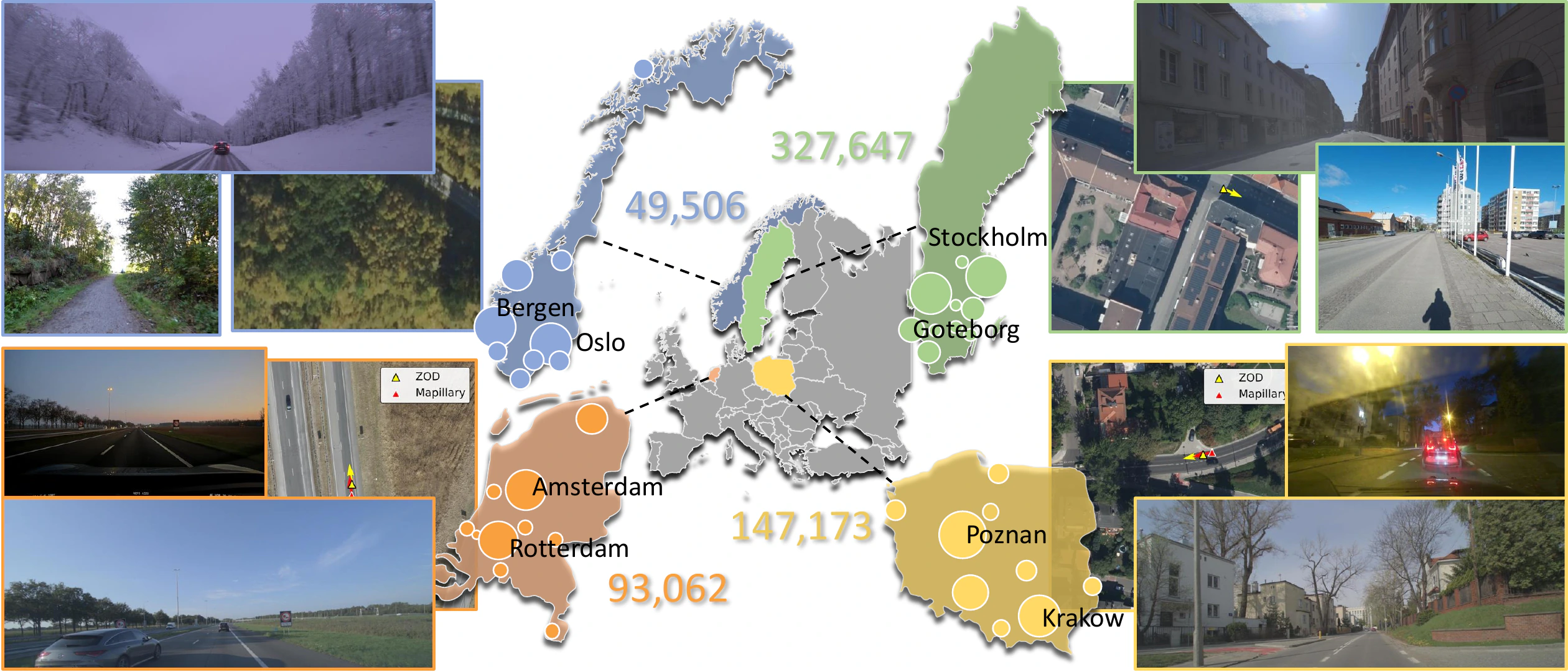
OpenCVL: An Open, Diverse, and Large-Scale Dataset for Fine-Grained Cross-View Localization
OpenCVL provides 617,388 ground-aerial image pairs across 41 cities in four European countries, combining calibrated and in-the-wild ground imagery with open aerial data to support scalable, reproducible fine-grained cross-view localization.
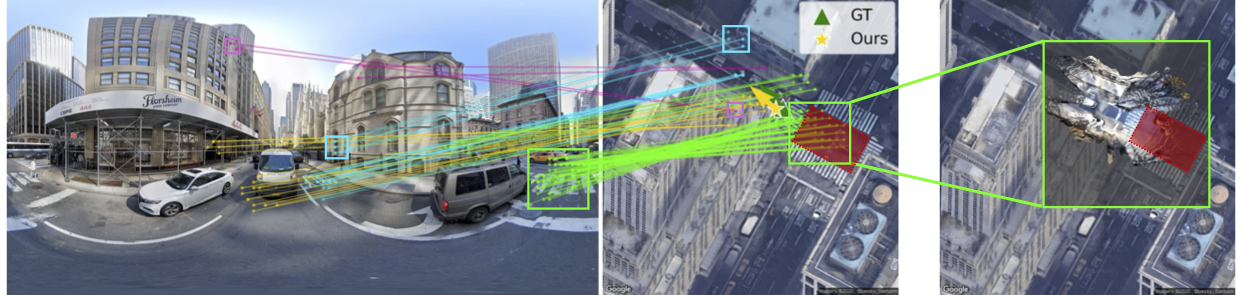
Loc2: Interpretable Cross-View Localization via Depth-Lifted Local Feature Matching
Learns interpretable ground-to-aerial correspondences, lifts them with monocular depth, and estimates pose through scale-aware alignment.
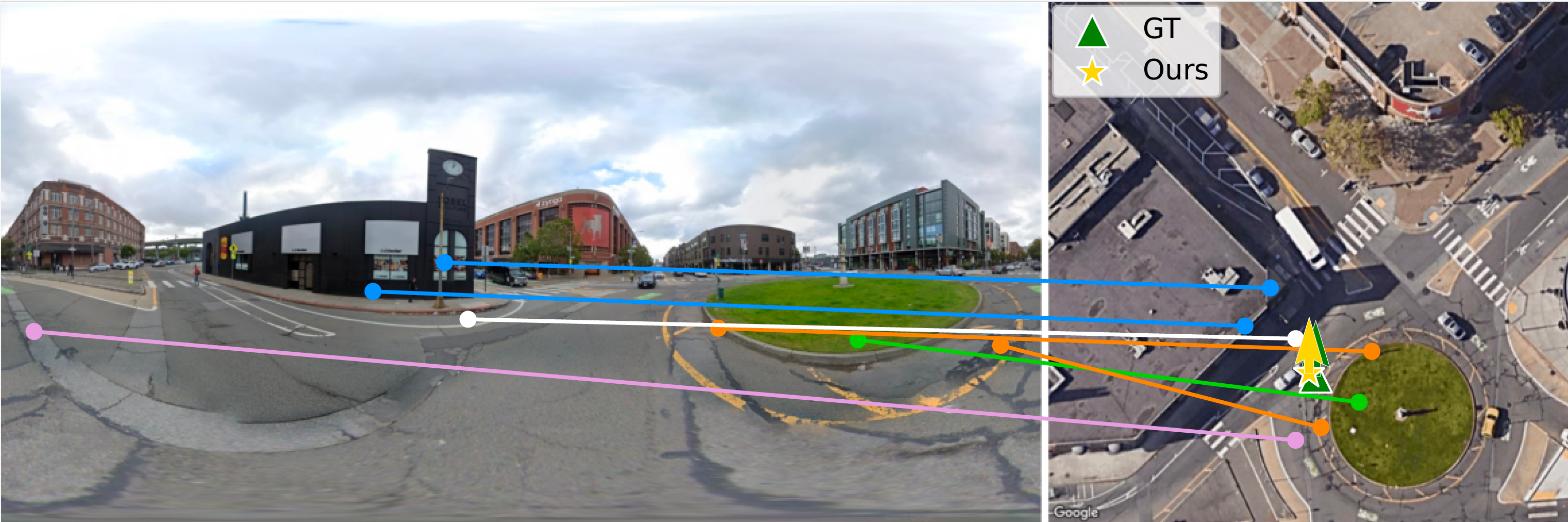
FG2: Fine-Grained Cross-View Localization by Fine-Grained Feature Matching
Pushes cross-view localization toward fine-grained pixel correspondences between ground-level perception and aerial imagery.
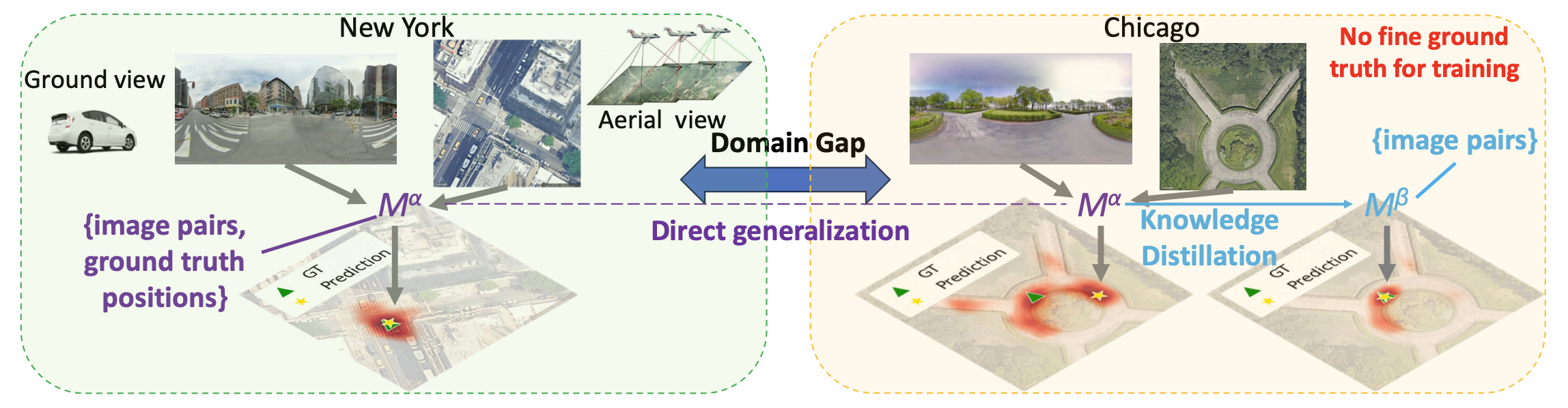
Adapting Fine-Grained Cross-View Localization to Areas without Fine Ground Truth
Adapts fine-grained cross-view localization to regions where accurate localization labels are unavailable.
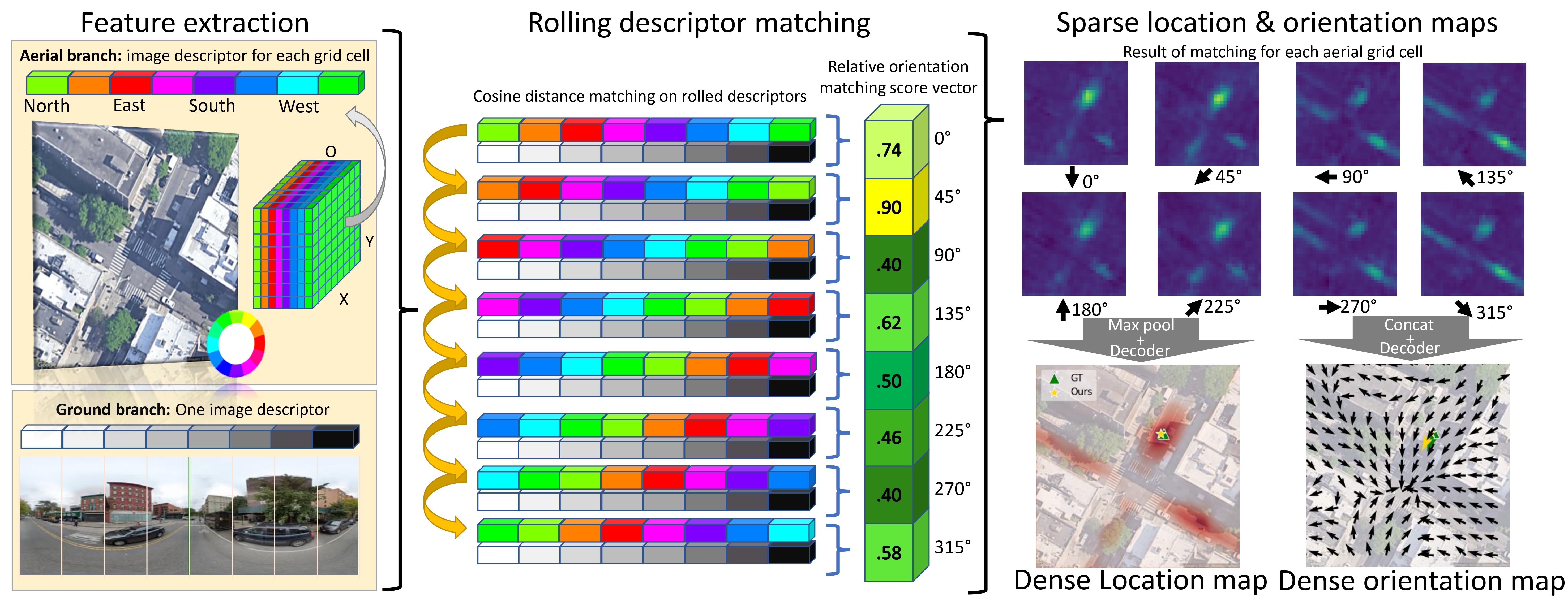
Convolutional Cross-View Pose Estimation
Formulates cross-view pose estimation with convolutional feature matching and spatial reasoning, turning dense ground-to-aerial evidence into a structured estimate of camera pose.
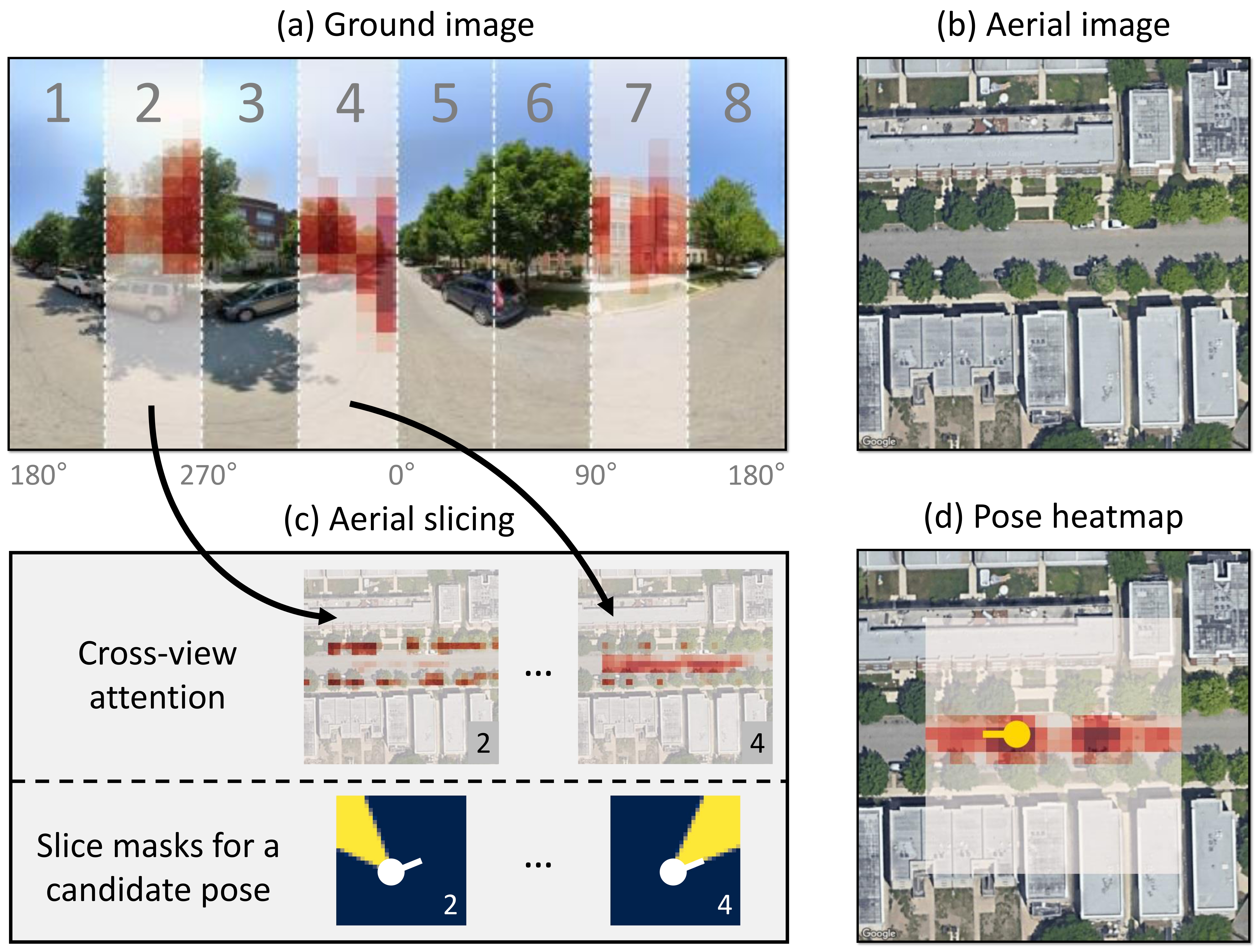
SliceMatch: Geometry-guided Aggregation for Cross-View Pose Estimation
Introduces geometry-guided aggregation to better align ground and aerial evidence for pose estimation.
Slice-specific cross-view attention and precomputed aerial slice masks allow the model to build pose-dependent descriptors efficiently, improving localization accuracy while keeping inference efficient.
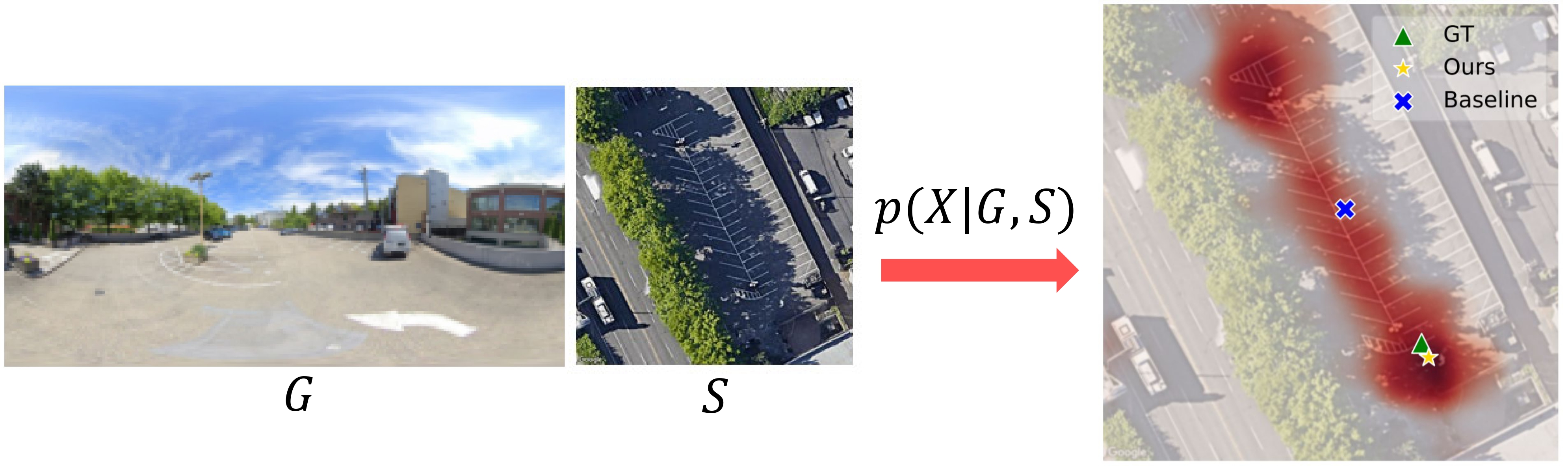
Visual Cross-View Metric Localization with Dense Uncertainty Estimates
Models dense uncertainty to improve metric localization when cross-view evidence is ambiguous or noisy.
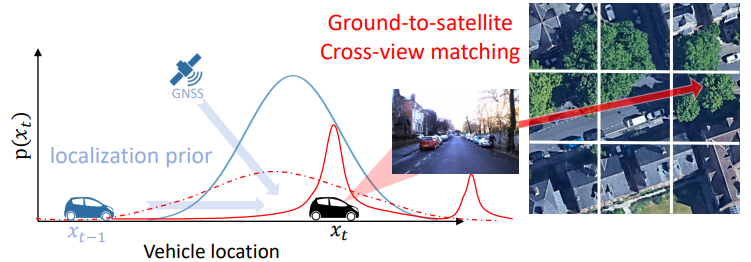
Cross-View Matching for Vehicle Localization by Learning Geographically Local Representations
Learns geographically local features to improve localization by embedding a spatial prior into the representation.
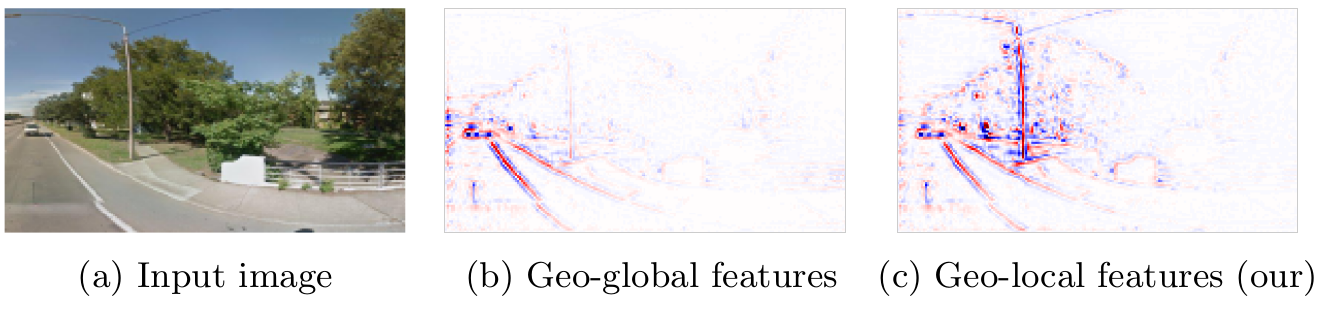
Geographically Local Representation Learning with a Spatial Prior for Visual Localization
An early step toward learning location-aware representations that remain grounded in geographic structure.
Invited talk
From Retrieval to Precision: Fine-Grained Cross-View Geo-Localization
Invited speaker for the tutorial Beyond Vision: Multimodal Perspectives for Cross-View Geo-Localization at WACV 2026.
References
- Howard Gardner. Frames of Mind: The Theory of Multiple Intelligences. Basic Books, 2011.